認定するRUCKUS RCWA関連資料 &合格スムーズRCWA日本語練習問題 |ユニークなRCWA試験資料
Wiki Article
さらに、Topexam RCWAダンプの一部が現在無料で提供されています:https://drive.google.com/open?id=1ybt5mgqCnbcm1yHJZqBzrvr3uv4TqTMW
RCWA学習ツールの魂としての「信頼できる信用」、経営理念としての「最大限のサービス意識」により、高品質のサービスをお客様に提供するよう努めています。あなたの小さなヘルパーになり、RCWA認定テストに関するご質問にお答えするサービススタッフは、すべてのユーザーとの包括的で調整された持続可能な協力関係を目指します。 RCWAテストトレントに関するパズルは、タイムリーで効果的な応答を受け取ります。公式ウェブサイトにメッセージを残すか、都合の良いときにメールを送信してください。
RUCKUS RCWA 認定試験の出題範囲:
| トピック | 出題範囲 |
|---|---|
| トピック 1 |
|
| トピック 2 |
|
| トピック 3 |
|
| トピック 4 |
|
| トピック 5 |
|
| トピック 6 |
|
RUCKUS 試験は、イメージをつかめばスッキリわかります!RCWA 問題集
今の競争が激しい社会にあたり、あなたは努力して所有したいことがあります。IT職員にとって、RCWA試験認定書はあなたの実力を証明できる重要なツールです。だから、RUCKUS RCWA試験に合格する必要があります。それで、弊社の質高いRCWA試験資料を薦めさせてください。
RUCKUS Certified Wi-Fi Associate Exam 認定 RCWA 試験問題 (Q75-Q80):
質問 # 75
When configuring a WLAN for 802.1X, which mode will provide authentication service for APs in the event of a controller failure?
- A. Non-proxy
- B. Proxy
- C. Local user database
- D. Dynamic PSK
正解:C
解説:
When configuring an 802.1X-secured WLAN, RUCKUS systems such as SmartZone, RUCKUS One, or RUCKUS Cloud typically rely on an external RADIUS server for user authentication. However, in the event of a controller failure or connectivity loss to the RADIUS server, RUCKUS APs can continue to authenticate users locally if the local user database is enabled and configured.
The Local Authentication Database allows APs or controllers to store a limited set of credentials that can be used when external AAA services are unavailable. This ensures continued access and redundancy for critical WLANs without requiring external dependency. According to RUCKUS One Online Help - WLAN Configuration and AAA Settings, enabling the Local Authentication Database provides fallback authentication for 802.1X clients during system or connectivity failures.
In contrast, the proxy and non-proxy modes define how authentication requests are relayed to the RADIUS server, while Dynamic PSK (DPSK) is a separate authentication method that replaces 802.1X with per-user keys.
Reference:
RUCKUS One Online Help - WLAN Configuration: AAA Authentication and Fallback Options RUCKUS Analytics 3.5 User Guide - Client Authentication and WLAN Events Ruckus Cloud / RUCKUS AI Documentation - Authentication Mode Descriptions
質問 # 76
Review the exhibit.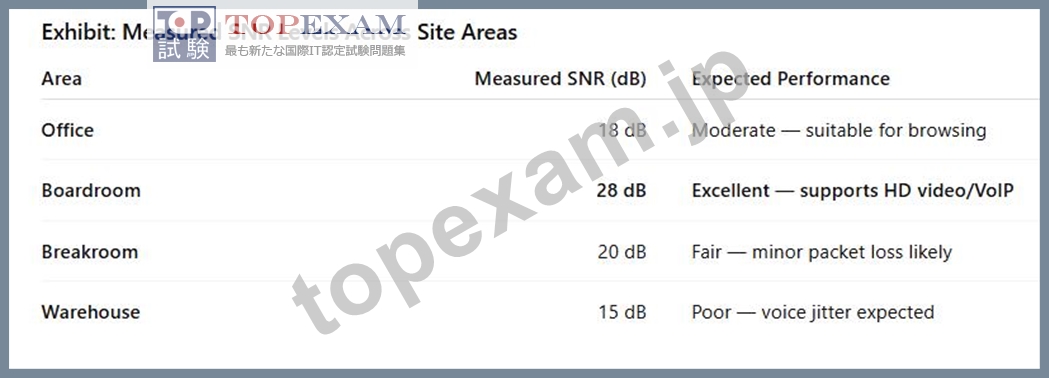
Which area has the proper SNR for optimal video and voice performance?
- A. Warehouse
- B. Boardroom
- C. Office
- D. Breakroom
正解:B
解説:
For optimal voice and video performance, RUCKUS recommends maintaining a Signal-to-Noise Ratio (SNR) of 25 dB or higher to ensure a clear, low-latency wireless link.
According to RUCKUS One Online Help - Wi-Fi Quality and SNR Thresholds and RUCKUS AI Documentation - VoIP and Streaming Application Optimization, SNR values above 25 dB correspond to high modulation and coding schemes (MCS8-MCS11 in Wi-Fi 6), supporting stable throughput with minimal jitter or packet loss.
The exhibit shows that the Boardroom maintains an SNR of 28 dB, which exceeds the recommended 25 dB threshold, making it ideal for HD video conferencing and VoIP applications.
Other areas (Office, Breakroom, Warehouse) fall below optimal levels, which can lead to voice dropouts, jitter, and reduced data rates.
RUCKUS Analytics 3.5 User Guide - Client Experience Metrics further validates SNR as a key indicator of real-time application quality.
Reference:
RUCKUS One Online Help - SNR and QoE Performance Standards for VoIP/Video RUCKUS Analytics 3.5 User Guide - Client SNR and MCS Analysis for Application Health RUCKUS AI Documentation - Real-Time SNR Monitoring and SLA Insights
質問 # 77
Which organization certifies wireless devices as interoperable across vendors?
- A. International Standards Organization (ISO)
- B. Internet Engineering Task Force (IETF)
- C. Wi-Fi Alliance
- D. Institute of Electrical and Electronics Engineers (IEEE)
正解:C
解説:
The Wi-Fi Alliance (WFA) is the global organization responsible for testing and certifying interoperability of wireless LAN products based on the IEEE 802.11 standards. While the IEEE develops and maintains the technical specifications (e.g., 802.11a/b/g/n/ac/ax), it does not perform certification or compliance testing. Instead, the Wi-Fi Alliance ensures that certified devices from different manufacturers operate together seamlessly under the "Wi-Fi CERTIFIED™" program.
According to RUCKUS One Online Help and the RUCKUS AI documentation, RUCKUS access points and controllers undergo Wi-Fi Alliance certification to ensure compatibility with a wide range of client devices, including those using WPA3, Wi-Fi 6 (802.11ax), and Wi-Fi 6E technologies. This certification is critical for enterprise environments where heterogeneous client ecosystems exist.
The IETF focuses on internet protocols (e.g., IP, TCP), and the ISO handles broader international standards, not wireless interoperability. Therefore, the Wi-Fi Alliance is the correct organization ensuring cross-vendor interoperability for Wi-Fi.
Reference:
RUCKUS One Online Help - Wi-Fi Standards and Certification Overview
RUCKUS AI User Guide - Wi-Fi Alliance Certification Compliance
Wi-Fi Alliance Official Resource (www.wi-fi.org)
質問 # 78
An administrator has completed a new install of SmartZone-Essentials for switch management, and has configured the SmartZone IP as the registrar IP on an ICX 7450. Which condition explains why the switch is not connecting?
- A. SmartZone is not configured to allow self-signed certificates.
- B. SNMPv3 is not enabled on SmartZone.
- C. DHCP options are not properly configured for the switch.
- D. SmartZone High Scale is required for ICX switch management.
正解:A
解説:
When deploying SmartZone-Essentials (SZ-100/SZ-144) for RUCKUS ICX switch management, the switches establish a secure HTTPS-based connection to the controller using the SmartZone registrar IP. A common issue preventing connection occurs when SmartZone is not configured to accept self-signed certificates-which are typically used by ICX switches by default for initial onboarding.
As described in the RUCKUS One Online Help - SmartZone Switch Management Setup and RUCKUS AI documentation, administrators must explicitly enable the option to "Allow Self-Signed Certificates" in the controller's Switch Management settings. Without this configuration, the SmartZone rejects the ICX connection request during SSL/TLS handshake, causing registration failure.
SNMPv3 configuration and DHCP options are unrelated to initial controller registration. Additionally, SmartZone-Essentials fully supports ICX management; SmartZone High Scale is not required.
Thus, the correct answer is C - the connection fails because the controller is not set to accept self-signed certificates from the switch.
Reference:
RUCKUS One Online Help - SmartZone Switch Management and Onboarding Configuration RUCKUS Analytics 3.5 User Guide - Device Connection and Registration Monitoring RUCKUS AI Documentation - ICX Switch Onboarding with SmartZone Essentials
質問 # 79
Which RUCKUS One capability provides centralized visibility of SLA compliance and end-user experience across multiple sites?
- A. ZoneDirector
- B. SmartZone Essentials
- C. RUCKUS Analytics
- D. SmartMesh
正解:C
解説:
RUCKUS Analytics is a cloud-based network intelligence platform integrated with RUCKUS One that provides service-level assurance (SLA) and end-user experience visibility across multiple sites and networks.
According to the RUCKUS Analytics 3.5 User Guide, it leverages AI-driven baselines and telemetry data from access points and switches to:
Detect anomalies
Measure Wi-Fi performance against SLAs
Generate detailed client experience reports
SmartZone Essentials handles local management, ZoneDirector is legacy controller software, and SmartMesh is a wireless backhaul technology-not a management analytics system.
Reference:
RUCKUS Analytics 3.5 User Guide - SLA Dashboard and Client Experience Analysis RUCKUS One Online Help - Integration of Analytics with Cloud Management RUCKUS AI Documentation - End-to-End Service Assurance and AI-driven Insights
質問 # 80
......
RCWA模擬テストは、シラバスの変更とRUCKUS理論と実践の最新の進展に応じて何百人もの専門家によって改訂された高品質の製品であり、各学生が重要なコンテンツの学習を完了することができるように焦点を絞ってターゲットを絞っています 最短時間で。 RCWAトレーニング準備では、RCWA試験を受ける前に20〜30時間の練習をするだけで済みます。 一方、RCWA試験の質問を使用すると、RUCKUS Certified Wi-Fi Associate Exam試験の焦点が失われることを心配する必要はありません。
RCWA日本語練習問題: https://www.topexam.jp/RCWA_shiken.html
- 試験の準備方法-高品質なRCWA関連資料試験-権威のあるRCWA日本語練習問題 ???? “ jp.fast2test.com ”の無料ダウンロード⮆ RCWA ⮄ページが開きますRCWA日本語試験対策
- RCWA模試エンジン ???? RCWA専門トレーリング ???? RCWAテスト問題集 ???? ウェブサイト☀ www.goshiken.com ️☀️を開き、【 RCWA 】を検索して無料でダウンロードしてくださいRCWA資格問題対応
- 実用的なRCWA関連資料一回合格-権威のあるRCWA日本語練習問題 ???? ➥ www.xhs1991.com ????で➠ RCWA ????を検索して、無料でダウンロードしてくださいRCWA日本語対策
- RUCKUS RCWA Exam | RCWA関連資料 - RCWA試験製品の無料ダウンロード ???? ▶ www.goshiken.com ◀で使える無料オンライン版➤ RCWA ⮘ の試験問題RCWA受験体験
- RCWA出題内容 ???? RCWA受験記対策 ???? RCWA専門トレーリング ???? ⮆ www.japancert.com ⮄で✔ RCWA ️✔️を検索し、無料でダウンロードしてくださいRCWA合格体験談
- RCWA関連日本語版問題集 ???? RCWA復習対策 ☀ RCWA難易度 ???? ➡ www.goshiken.com ️⬅️から簡単に➥ RCWA ????を無料でダウンロードできますRCWAテスト問題集
- RCWAテスト内容 ???? RCWA資格問題対応 ???? RCWA受験体験 ???? ▶ RCWA ◀を無料でダウンロード( www.jpshiken.com )で検索するだけRCWA資格問題対応
- RCWA関連資料|信頼に値するRCWA日本語練習問題いい評価RUCKUS Certified Wi-Fi Associate Exam ???? 今すぐ( www.goshiken.com )で( RCWA )を検索し、無料でダウンロードしてくださいRCWA出題内容
- 実用的なRCWA関連資料一回合格-権威のあるRCWA日本語練習問題 ???? 最新▷ RCWA ◁問題集ファイルは⮆ www.xhs1991.com ⮄にて検索RCWA過去問無料
- 権威のあるRCWA関連資料一回合格-素晴らしいRCWA日本語練習問題 ⬅️ 時間限定無料で使える「 RCWA 」の試験問題は{ www.goshiken.com }サイトで検索RCWA受験体験
- 権威のあるRCWA関連資料一回合格-素晴らしいRCWA日本語練習問題 ???? 【 jp.fast2test.com 】を開いて✔ RCWA ️✔️を検索し、試験資料を無料でダウンロードしてくださいRCWA試験勉強過去問
- allenqsqr789384.newsbloger.com, 1stlinkdirectory.com, singnalsocial.com, socialrus.com, thebookmarkid.com, artybookmarks.com, listedirectory.com, onelifesocial.com, socialwebleads.com, myfirstbookmark.com, Disposable vapes
さらに、Topexam RCWAダンプの一部が現在無料で提供されています:https://drive.google.com/open?id=1ybt5mgqCnbcm1yHJZqBzrvr3uv4TqTMW
Report this wiki page